Not All Who Wander Are Lost

Not All Who Wander Are Lost
June, 2019 - Mount Denali, Alaska

Monday, January 15, 2024

Christchurch, New Zealand - November 7, 2023

 Our next port of call was Lyttelton, about eight miles from Christchurch. This was another commercial port with bus service to Christchurch. 

Commercial port in Lyttelton

View of Lyttelton from the ship

We booked an excursion through Princess to the mountains and Erewhon Station.

It was about a two hour drive through the vast Canterbury Plains where we saw many farm fields and cow and deer stations. A station is what they call a farm or ranch. Dairy has become the main export of New Zealand. They also raise deer to export the meat to Asia.


In both of the pictures above, you can see rows of trees around the pastures. It is often very windy in the plains, and the farmers have planted walls of trees or hedges around the fields to protect the crops and animals.

After two hours of driving on paved roads, we pulled onto a gravel road for about another hour to get to the sheep station. We were now in the beautiful mountainous area referred to as the Southern Alps.


When we booked this tour, one of the sites advertised was Mount Sunday which was Edoras in the second Lord of the Rings movie. I was expecting a mountain. Our guide pointed it out to us, and we had a hard time figuring out where it was. That's because it was a small looking hill in front of the big mountains.
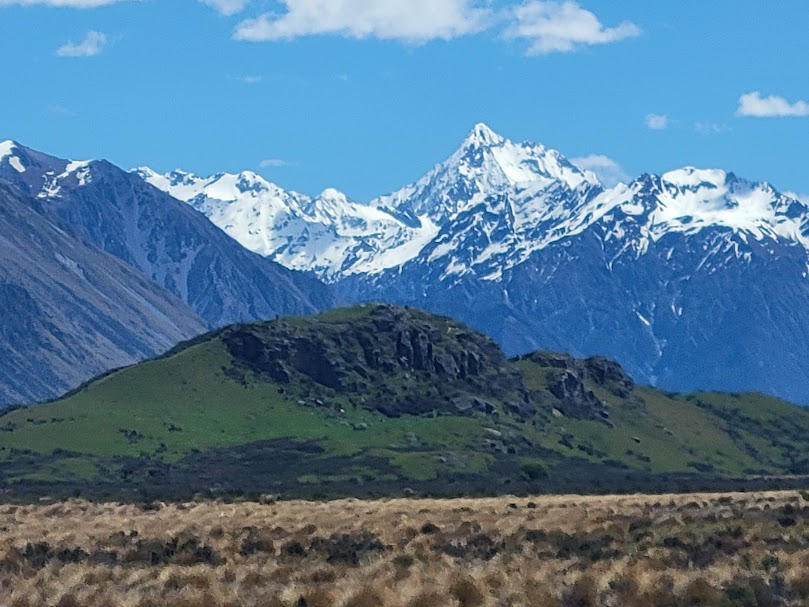

The movie people spent about nine months building the set out here in the wilderness. After several days of filming, the entire set was disassembled and taken away. Here are some pictures from the movie showing you what they built out here on top of that hill called Mount Sunday.


Hard to believe it's the same place. We continued on over a few streams and arrived at Erewhon Station, which was literally at the end of the road. Here we met Colin and Erin who own this amazing place. They raise Merino sheep, Clydesdale horses, Hereford cattle and deer. 

We were fed a delicious lunch while we watched a video of the workings of the station. Erewhon Station is a 35,000-acre working farm situated in the foothills of the Southern Alps.

Next, Erin took us on a horse drawn wagon ride through their property.


We saw lots of sheep. As it was spring here in New Zealand, we also saw many lambs. They were so very cute!


This Clydesdale foal was so adorable! The owners are very involved in raising and showing these magnificent  horses. As they are located in the high country, it is often easier to do the farm work with the horses rather than machinery.


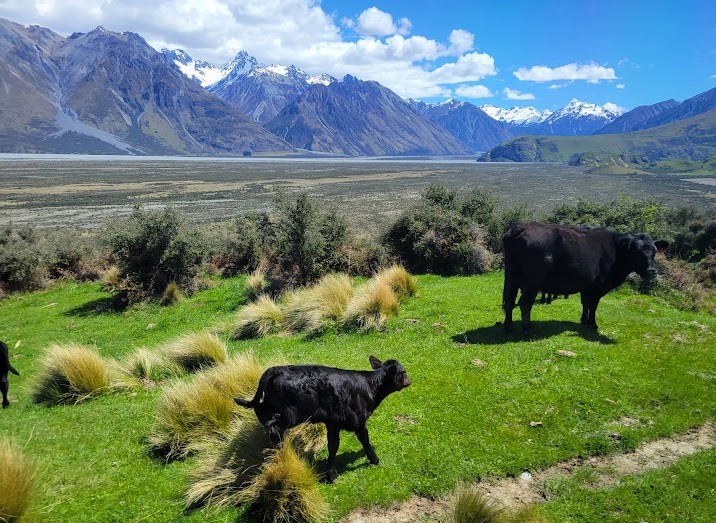
This is some of the scenery from their farm. Their land actually goes about half way up these mountains. Herding the sheep back to the farm for sheering is an arduous process!


Colin gave us a demonstration of how he uses the sheep dogs to herd the sheep. Those poor sheep didn't have a chance. One of the dog's job is to bark like crazy at the sheep. He did his job very well. The other dog chases and rounds them up.


These sheep were in a pen ready for sheering which was to begin the next day. Groups of farmers get together and do all of the sheering at one place. While we were there, two semitrucks full of sheep arrived for the next day sheering.


They were in the process of building a new house for the owners and some of the employees. Being in such a remote location, they have employees who live on the property. It was quite fascinating to hear how they work out all of the logistics of running such a large operation in such an isolated location.


Before we knew it, it was time to head back to the ship. We were at the farm for about four hours, and the time went by so quickly. What a fascinating place to visit. On the way out, we saw some of the steer and this calf. The scenery was just fabulous wherever we were on the station and much of the ride back.


One of the things we noticed in Australia and New Zealand is that your tour bus driver is also the tour guide. Our driver/guide on this excursion was Natasha. She was a native Kiwi (that's what they call themselves in New Zealand), and she was full of information during the six hours we spent on the bus. The time went by so quickly as she told us about the history of her country and much of what life is like. Whenever someone on the road did something she liked, she would say "good on ya, mate". I loved listening to her accent. 

This was another wonderful and enjoyable day in New Zealand. Such a unique place to visit!

Don’t wish upon a star – Reach for one!

Sunday, January 7, 2024

Dunedin - Port Chalmers, New Zealand - November 6, 2023

As we sailed into our first port of call in New Zealand, Port Chalmers, I was amazed to see how green everything was.


I was also surprised how hilly most of the port cities were. Lots of sheep grazing on those green hills! In New Zealand, sheep outnumber humans about five to one. It used to be much more, but the demand for wool has diminished. Now, they raise dairy cows, and export a lot of dairy products to Asia.


Coming into the port, we saw some albatross birds on the Otago Peninsula. This is where the Royal Albatross Centre is located. It is home to the world's only mainland Royal Albatross Breeding Colony. It was quite a distance away, so I mainly only saw white spots. I did manage to zoom in and get this slightly blurry picture of an albatross. They are very large birds with a wing span of almost 10 feet. (Remember, you can click on any of the pictures to enlarge them.)

Almost all of the ports we sailed into were commercial ports. Most of them had a great deal of lumber stacked up waiting for export. One of our tour guides told us that most of the ports only have one or two cruise ships arrive per week. Although tourism is an important part of their economy, it is not like the Caribbean or Mexico where the ports are geared specifically to the tourists. Most of the attractions at this stop were actually in Dunedin, so there were busses to take the passengers on pre-booked excursions or into town.


Princess once again messed up our excursions at this stop. I had booked us both an excursion to Larnach Castle. It got cancelled the day before we arrived. There was nothing else available that we were interested in. After talking to the excursion desk manager, he was able to get me one ticket to the castle. I ended up going without Kevin. There were two empty seats on the bus, so I don't understand how Princess screwed this up for us.

Dunedin was established by Scottish immigrants. Larnach Castle was built by William Larnach in 1871. He had made his fortune in banking and then land speculation, farming investments, timber and politics.

It took 200 men three years to build the shell and another 12 years for master craftsmen to finish the interior. Here's a painting of what it looked like shortly after completion, and a photo when I was there. It seems they could park the busses a bit further away, so they wouldn't be in people's photos.


The interior was spectacular with amazing carved wooden ceilings. The attention to detail by the craftsmen was mind boggling.


The grounds were also beautiful. We were there in November, which is spring. Many of the flowers were not blooming yet. These hedges were around much of the property.


Here's the front courtyard overlooking the bay.


I bet this arbor is gorgeous when the vines are blooming.

William had three wives. The first two both died at age 38 and were half sisters.  He had six children with his first wife. The third wife was considerably younger than William, and rumored to have had an affair with William's youngest son. William Larnach committed suicide by shooting himself in the Parliament building. Rumors were that he was on the verge of bankruptcy, and that he discovered his wife was pregnant with his youngest son's child. Sadly, that son also committed suicide. So, even though this family had great wealth, it sure didn't bring them happiness.

The castle fell into ruin for years. In 1967 the Barker family purchased it and began the endless project of restoring it. They have turned it into a tourist attraction, as well as hosting weddings and other parties. It is now designated a New Zealand Heritage Landmark. The gardens have been given the rating of Garden of International Significance.

In the gift shop, I found some very soft scarves, hats and gloves. I got a good laugh out of the attached tags. New Zealand has had a real issue with non-native possums causing lots of problems. It seems they've found one way to help control the possum population. Combine the fibers with Merino wool and make clothing items! The possum fibers are hollow, which makes them light and warm. 

Here's a view of the bay as we made our way back to the city of Dunedin.

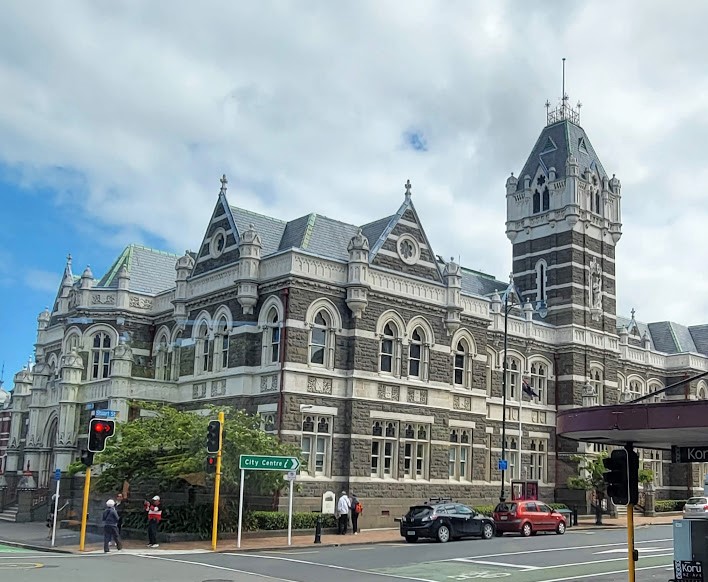
This building in Dunedin is the Law Courts Building built in 1902.

I enjoyed my visit to Dunedin and Larnach Castle. Too bad Kevin couldn't come with me. He did walk into the town of Port Chalmers from the ship, and found a local brew to sample.

Don’t wish upon a star – Reach for one!

Tuesday, January 2, 2024

Fiordland National Park, New Zealand - November 5, 2023


We left Sydney once again on November 2nd for our 13 day cruise to New Zealand. The first two days were at sea. On the morning of November 5th, I woke up around 6 am and looked out the patio door. The most surreal and amazing views were all around us. It was a bit cloudy which made it look somewhat eerie. We had arrived at Milford Sound in Fiordland National Park!


Fiordland National Park is on the southern tip of the South island of New Zealand. It is one of the wettest places on the planet with about 182 days of rain and fog per year. As we were in the southern hemisphere, the further south you were, the colder it was. Temperatures on this day were in the 30s with a cold wind straight from Antarctica. 

I had read many reports from others who had traveled here that it was very foggy, and they couldn't see much at all. We were so fortunate to have good weather. As the day progressed, the sun came out, and we had near perfect conditions to travel through the park.

Our ship did a 360 degree turn in Milford Sound so everyone could get a great view. A smaller ship came alongside and a park ranger/naturalist came on board to teach us all about the park as we travelled along. 

Here is one of the waterfalls in Milford Sound. Milford Sound is often described as the eighth wonder of the world.


This was a great day to have a balcony room. The bridge cam was on our TV all day, and we could hear everything that the naturalist was saying while watching the amazing scenery either on the balcony or looking out the patio door. As I said, it was quite cold, so we were glad we didn't have to spend the entire day outside.

We learned a lot of facts from the naturalist. 

In New Zealand it is spelled fiord; in Norway it is spelled fjord.

A fiord is created from glaciers. A sound is a river valley that has been flooded with sea water.

The park was founded in 1952, and covers 3.1 million acres and is 5% of New Zealand's land area.

Fiordland National Park contains mountains, 14 fiords, marine reserves, rugged coastline, temperate rain forests, alpine areas, freshwater lakes and varied wildlife.

It took the entire day to sail through the park. Two other sounds we traveled through were Doubtful and Dusky Sounds. Captain Cook and his crew were the first Europeans to visit Fiordland in 1773, and spent five weeks in Dusky Sound. Cook named it Doubtful Sound because he doubted they could sail into it.

Each area was a little different; some with mountains, others with very green hills, and lots of waterfalls and islands. Here are some of the many pictures I took. 


And, here are some of the waterfalls we saw.


As we came out of the last fiord back into open waters, we passed the Five Fingers Peninsula.


This was truly another spectacular day with the most amazing scenery we've ever seen. Our planet has so much beauty. We are so grateful to have seen just a small fraction of it!!

Don’t wish upon a star – Reach for one!